20th ERCOFTAC Da Vinci Competition 2025 - Interview with Da Vinci Winner
Thomas Monahan
(University of Oxford, UK)
"Spatiotemporal Tidal Prediction and Analysis Using Physics-Informed Ml"
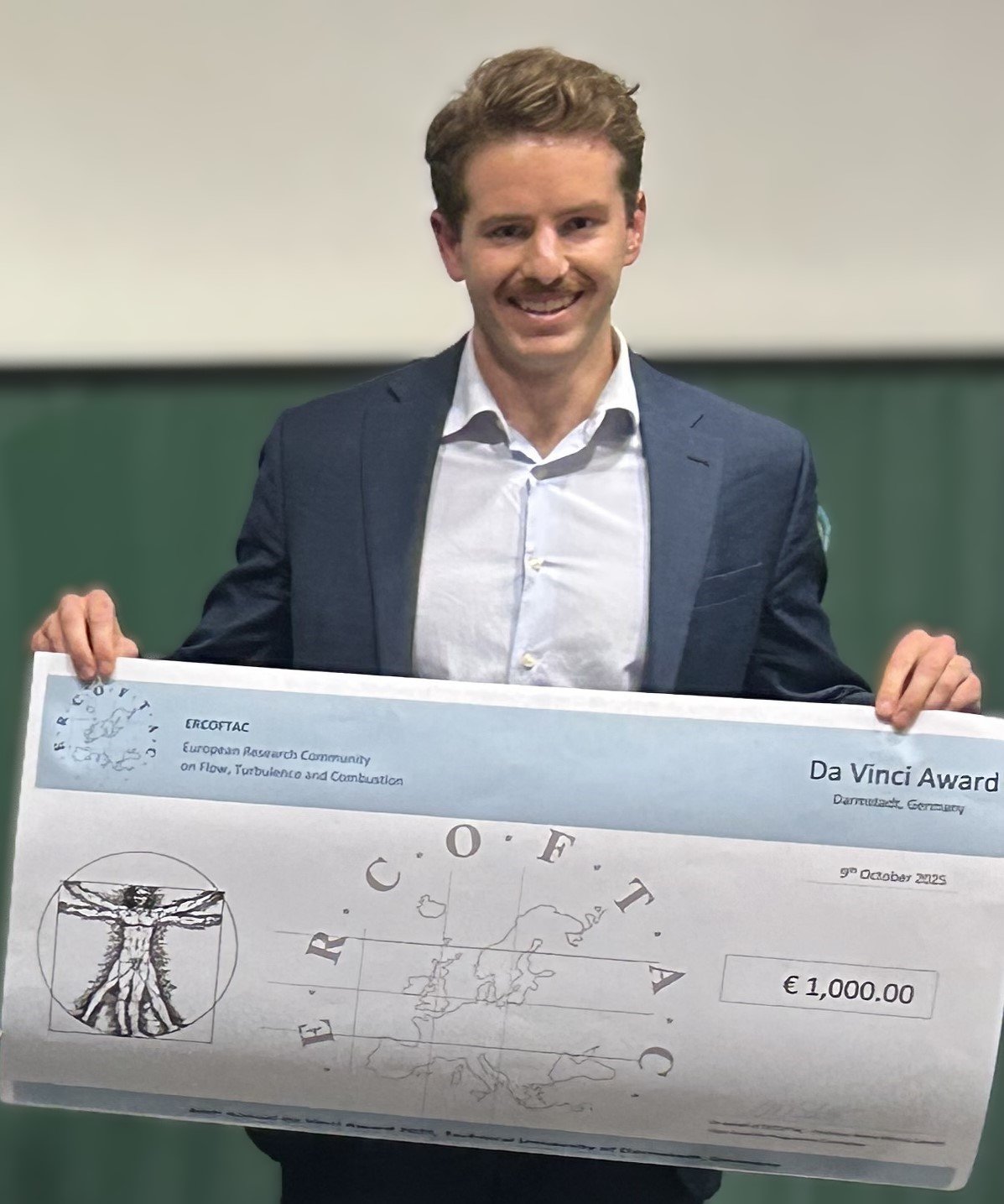
Thomas Monahan - winner
of 20th Da Vinci Competition 2025
- What is the topic of your PhD thesis?
My thesis looked to improve the study and prediction of tidal processes using scientific machine learning. Tidal processes are large scale geophysical fluid flows which are partially driven by gravitational forcing from the moon and sun. These processes are incredibly powerful, shaping our global coastlines, driving coastal flooding, and can even be harnessed for renewable energy production. In my thesis, I developed a new framework for the analysis and prediction of tidal processes which has overcome many of the limitations of existing methods. This has been a breakthrough in flood forecasting, now being used by the UK and Dutch governments, and has the potential to deliver accurate and timely forecasts globally. It also is a great example of how scientific machine learning is enabling new scientific investigations into sea-levels.
- What does the Da Vinci competition mean to you and what does winning mean to you?
Winning the Da Vinci competition has been an enormous honour. To be recognized out of such a diverse and talented field has affirmed for me the potential this work to change my immediate field and impact the broader fluids community.
- What did trigger your interest in STEM ?
As long as I can remember I always enjoyed STEM which I think is driven by a desire to understand how things work. In my coursework/lectures, however, I don’t think I ever really came into my own.
My passion for STEM properly began during my first NASA internship where I was fortunate to be involved with developing one of the first fully autonomous machine learning algorithms for the DAVINCI+ space craft to study Venus’ atmosphere (a mission sadly now cancelled under the administration. Having the opportunity to push the boundaries of what was possible on a real-world problem was awesome. I also found that learning things on the fly, and out of the structure of the classroom, gave me a newfound curiosity and joy for science.
- Do you have any advice for others in STEM?
The beauty of stem is its diversity. There are so many subdisciplines and varying skillsets that are needed to succeed in different tasks. By far the most enjoyable part of STEM for me has been working with people with completely different skillsets to solve really hard problems.
- What motivates you in your work?
A mixture of curiosity and a drive for impact. While I am fascinated by the science which underlies my research, I believe this work has the potential to save lives and improve the safety of our coastal communities going forward. Seeing this through to its fullest potential is extremely compelling to me.
- Where do you see yourself in five years?
Since winning the Da Vinci prize I have been fortunate to start building a small team in Oxford working to expand these methods to solve longstanding challenges in sea-level science and beyond. I hope to continue this work and expand my team to ensure that every coastal community in the world has access to timely and accurate flood warnings as well as an understanding of how these risks will evolve in the future. I also hope and expect to find myself working on a new set of problems which is maybe the best part of science.
- What advice would you give to new PhD students starting in fluid mechanics?
Fluid mechanics is an enormous field encompassing all kinds of engineering, mathematics, and physics. I think the best way to start a PhD is to first pick a problem which you care about and use that to guide your research and learning. This ensures we are working to solve problems rather than find problems for a given solution.
Da Vinci Presentation available here
Paper summary
Date: ERCOFTAC Autumn Festival 9th - 10th October 2025
Department of Mechanical Engineering, Technical University of Darmstadt (Campus “Lichtwiese”)
Hosted by Pilot Centre Germany: TU Darmstadt, Germany
 Pilot
Pilot Special Interest
 Knowledge
 ERCOFTAC