20th ERCOFTAC Da Vinci Competition 2025 - Interview with Da Vinci Finalists
Jean-Jacques Hok
(CERFACS, France)
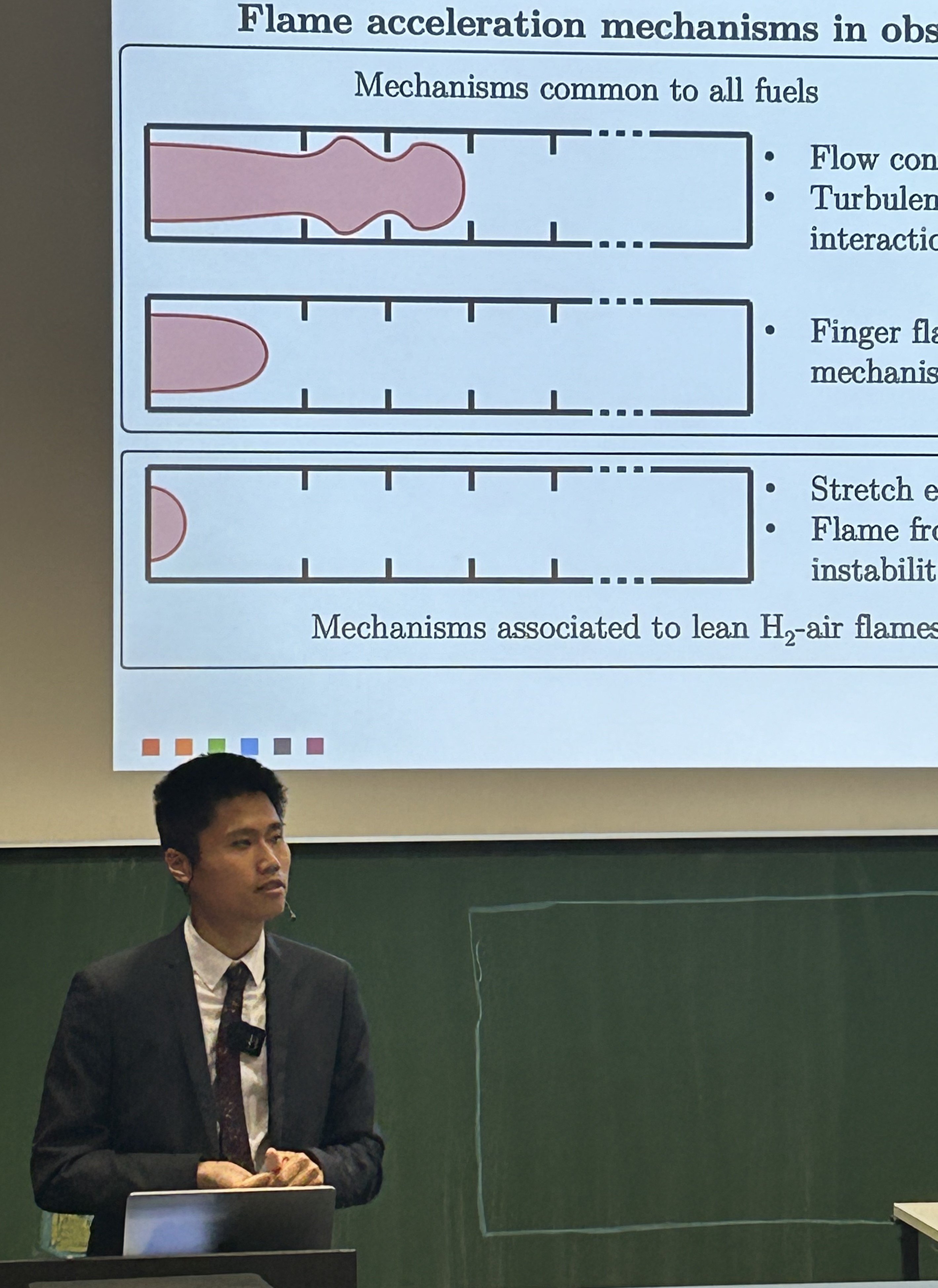
Jean-Jacques Hok - finalist
of 20th Da Vinci Competition 2025
- What was the topic of your PhD thesis?
"Modeling Strategy for the Large Eddy Simulation of Lean Hydrogen-Air Explosions"
- What does the Da Vinci competition mean to you?Being selected as one of the five finalists of the Da Vinci competition is an achievement to me. Fluid mechanics has many applications and the ERCOFTAC community gathers researchers across Europe, so the Da Vinci prize represents one of the most prestigious awards in the field. I realised it was an opportunity to present my work to a jury and a large audience, somehow like a conference, but with higher stakes!
I did my PhD in numerical combustion for hydrogen. The advent of hydrogen as a clean energy vector is welcome, but it inevitably raises many questions in terms of safety. Its properties indeed make it prone to explosions (high susceptibility to leaks, wide flammability range, low minimum ignition energy, high flame speed and flame temperature). So I worked on developing a high-fidelity modelling approach for hydrogen explosions. It involved understanding the particular physics related to lean hydrogen-air flames (namely flame front instabilities and stretch effects) and proposing a detailed model for use in Large-Eddy Simulations. The overarching goal is to provide numerical tools to better design future hydrogen technologies throughout the whole chain (production, transport, storage, use).
- What did trigger your interest in STEM?
- Do you have any advice for others in STEM?
- What motivates you in your work?
- Where do you see yourself in five years?
- What advice would you give to new PhD students starting in fluid mechanics?
I think I have interest in STEM since I was ten or so. My big brother probably triggered it by teaching me maths during holidays, but also my parents who have always encouraged us to pursue higher education and land high-qualification jobs. STEM not only provides tools to understand our physical world, but also allows us to design technologies that can and should be useful to everyone.
STEM is so diverse. Try exploring as much as you can to find the field that best fits you.
I initially graduated from an engineering school with a generalistic background. I found interest in many domains so I wanted to work in a field gathering several disciplines. Combustion totally does the job: reactive flows, thermodynamics, thermal transfers, acoustics, radiation and a lot more. And of course I found it exciting to work on hydrogen as a disruptive technology which I hope will help society.
This is probably related to my answer to the previous question. I am always eager to learn and work in multi-physics. So I recently transitioned from combustion to atmospheric sciences. Surprising? Not really if you look closer at each system. Combustion chambers and the Earth's atmosphere are very similar, but at different scales, aren't they? So today I don't know in which exact field I will be working in five years, but probably one that involves a lot of different physics!
Do not neglect the working environment. The PhD topic is of course a prime criterion. But your supervisors, your colleagues and the infrastructure is important for a successful thesis. Having supervisors and colleagues you are happy to work with will certainly help you in that challenging period of your life. And try to find a proper work/leisure balance.
Da Vinci Presentation available here
Paper summary
Date: ERCOFTAC Autumn Festival, 9th - 10th October 2025
Department of Mechanical Engineering, Technical University of Darmstadt (Campus “Lichtwiese”)
Hosted by Pilot Centre Germany: TU Darmstadt, Germany
 Pilot
Pilot Special Interest
 Knowledge
 ERCOFTAC