The ERCOFTAC Course Surfing the Ripple: Fundamentals of Liquid Film Dynamics took place on the 20th – 21st April 2026 in the beautiful setting of the Zeeman Building in the Mathematics Department of the University of Warwick in the United Kingdom.
The organising committee coordinated this informal event to broaden the perspectives of students and young researchers through a series of lectures and workshops given by seven internationally renowned speakers on analytical, numerical, and experimental methods, as well as data visualisation and scientific communication, constructed to serve as a strong foundation for developing (or extending) the toolkit of the modern specialist in the area of liquid film flow dynamics.
The success of this event would not have been possible without the ERCOFTAC’s support. In this respect, the organisers express their deep gratitude to the Committee for accepting their proposal. The association’s financial contribution enabled several students to attend the event, helping to offset their travel and accommodation costs. The teamwork between passionate and dynamic researchers and institutions, such as ERCOFTAC, is what allows the academic environment to thrive and attract many more young students to investigate its wonders, as in this case, in the vibrant field of liquid film dynamics.
Full report from the event will be published in ERCOFTAC Bulletin.
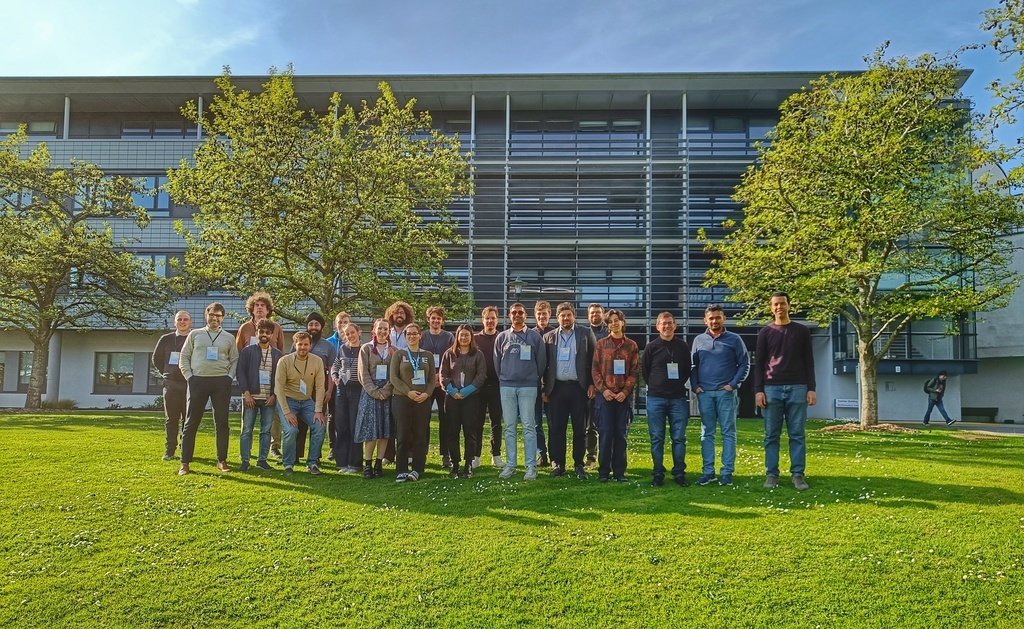
Figure 1: Group picture at the University of Warwick in front of the Zeeman Building.
The detailed programme of the event, including the abstracts of each contribution, is available at the following LINK
Organising and Scientific Committee:
- Dr Fabio Pino, University of Cambridge, Cambridge, United Kingdom - postdoctoral researcher specialising in the theoretical analysis of liquid film flows. His expertise includes reduced-order modelling, stability analysis, numerical simulations, and control strategies (including machine learning), with applications ranging from coating and evaporating and condensing films to industrial systems such as hot-dip galvanising and heat exchangers. He will lead the theoretical and numerical components of the course, focusing on reduced models and machine learning.
- Dr Radu Cimpeanu, University of Warwick, Warwick, United Kingdom - an applied mathematician with expertise in scientific computing, liquid film simulations, multiphysics modelling, and feedback control. His research spans nonlinear interfacial dynamics, wave propagation, and industrial applications such as lab-on-a-chip and precision coating. He has broadexperienceinknowledgetransferandindustrialmathematics,makinghimakeycontributor to the computational aspects of the programme.
- Dr Susana Gomes, University of Warwick, Warwick, United Kingdom - is an applied mathematician specialising in PDE control, optimisation, and nonlinear dynamics, with applications to thin-film stability, coating, and heat exchange. Her expertise include passive and active control strategies, reduced models, and robust stabilisation methods. She also bringsextensiveexperienceinknowledgeexchangeandworkshoporganisation.Shewillcoordinate the theoretical components and link them with numerical and experimental work.
- Dr Emmanouil Chatzigiannakis, Eindhoven University of Technology, Eindhoven, Netherlands - is an experimentalist working at the interface of soft matter physics, interfacial rheology, and polymer–fluid interactions. His research covers thin-film dynamics,droplet/bubble coalescence, and viscoelastic interfaces. Using advanced rheometric methods, he explores interfacial stresses and their role in film stability. He will lead the experimental sessions, ensuring strong integration with theoretical and numerical perspectives.
Speakers:
- Dr. Thomasina V. Ball (University of Warwick)
- Dr. Lyes Kahouadji (Imperial College London)
- Prof. Guntars Kitenbergs (University of Latvia)
- Dr. Vrionis Panayiotis-Yiannis (The Cyprus Institute)
- Prof. Benoit Scheid (Université Libre de Bruxelles)
- Prof. Christian Ruyer-Quil (Université Savoie Mont Blanc)
- Dr. Kat Phillips (University of Warwick)
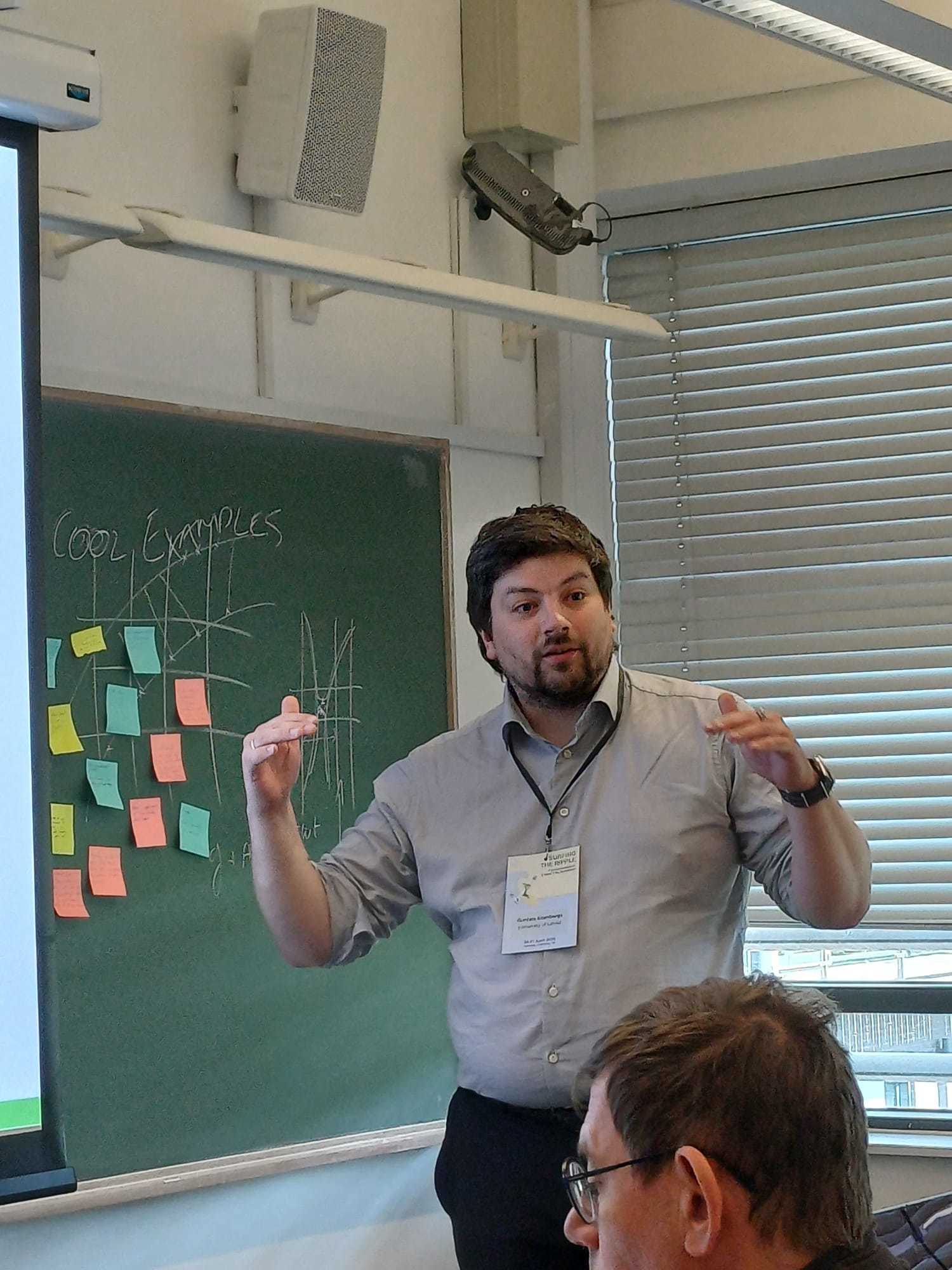
Prof. Kitenbergs while introducing PIV methods for magnetohydrodynamics experiments.
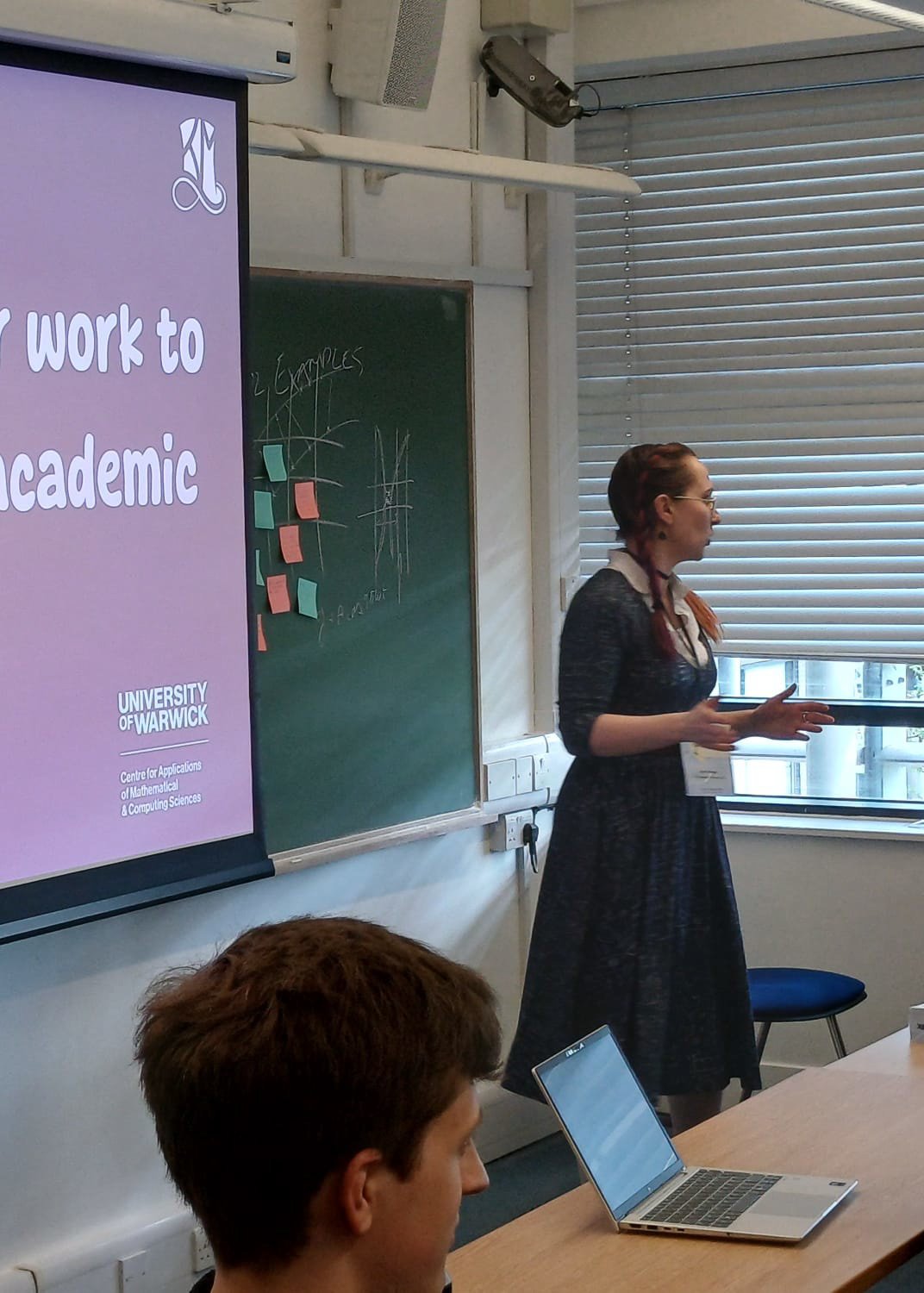
Dr. Phillips while exchanging
perspectives with the participants.
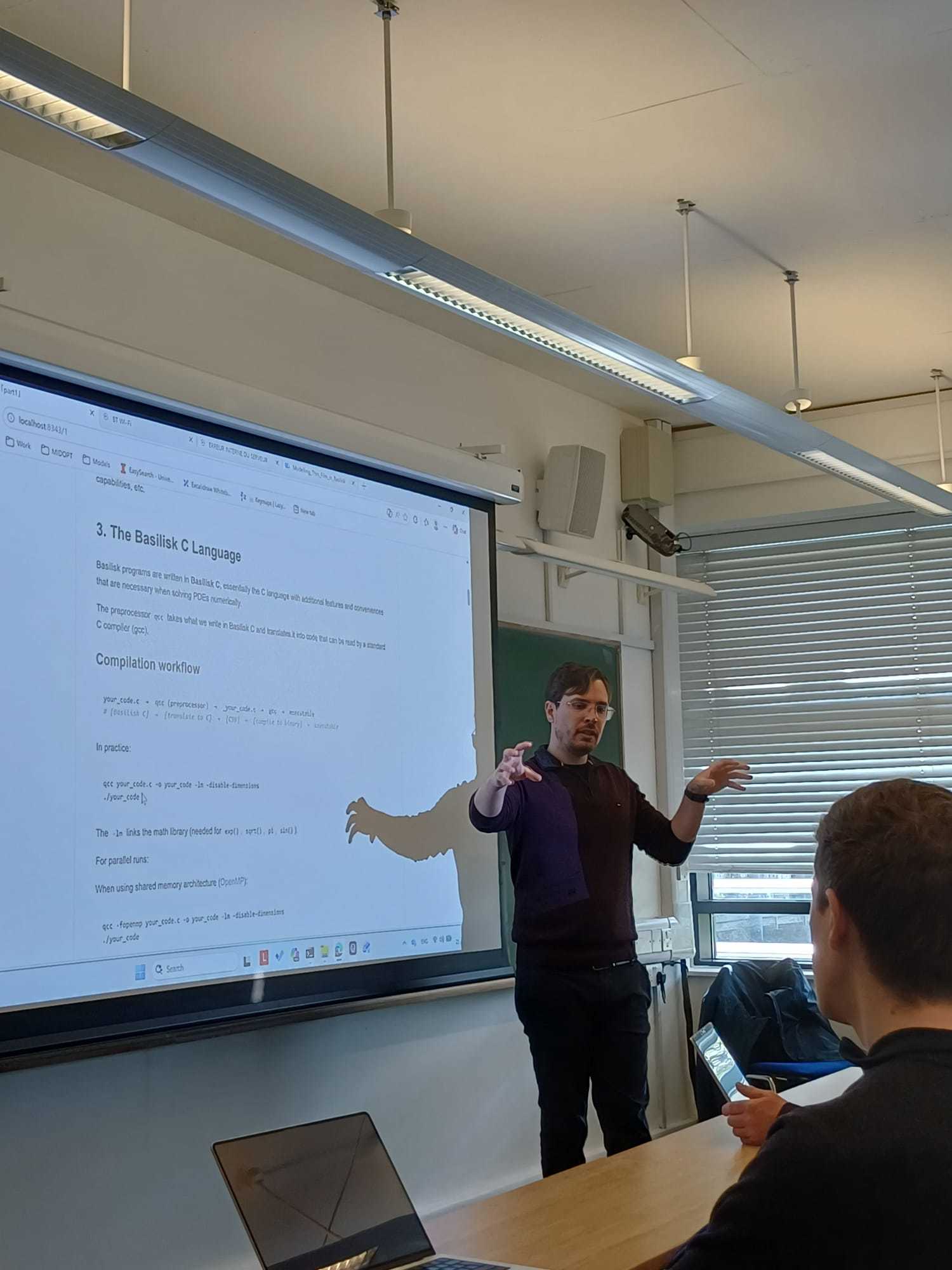
Dr. Panayiotis-Yiannis guiding the
participant through the Basilisk tutorial
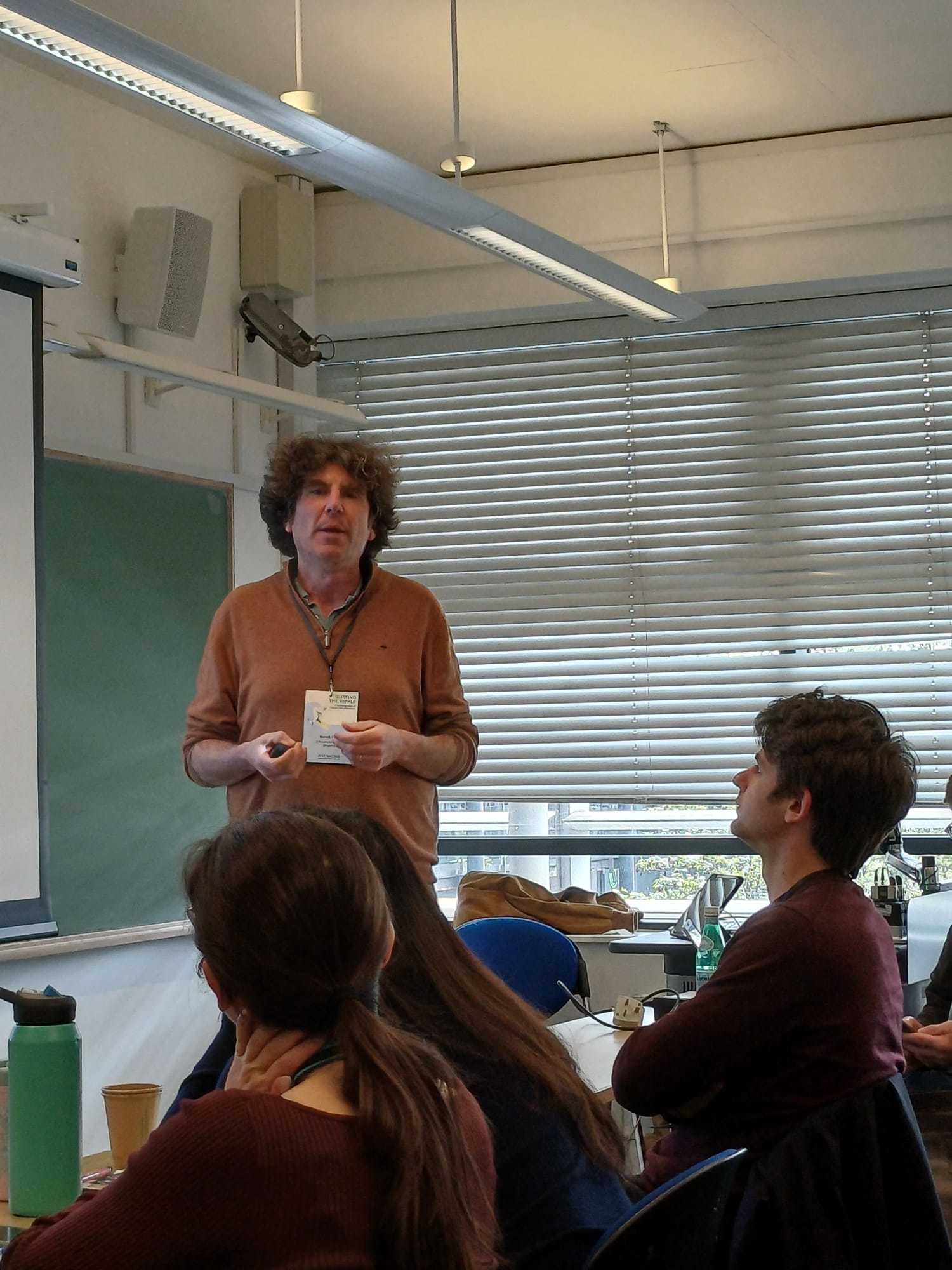
Prof. Scheid while talking about the draw resonance
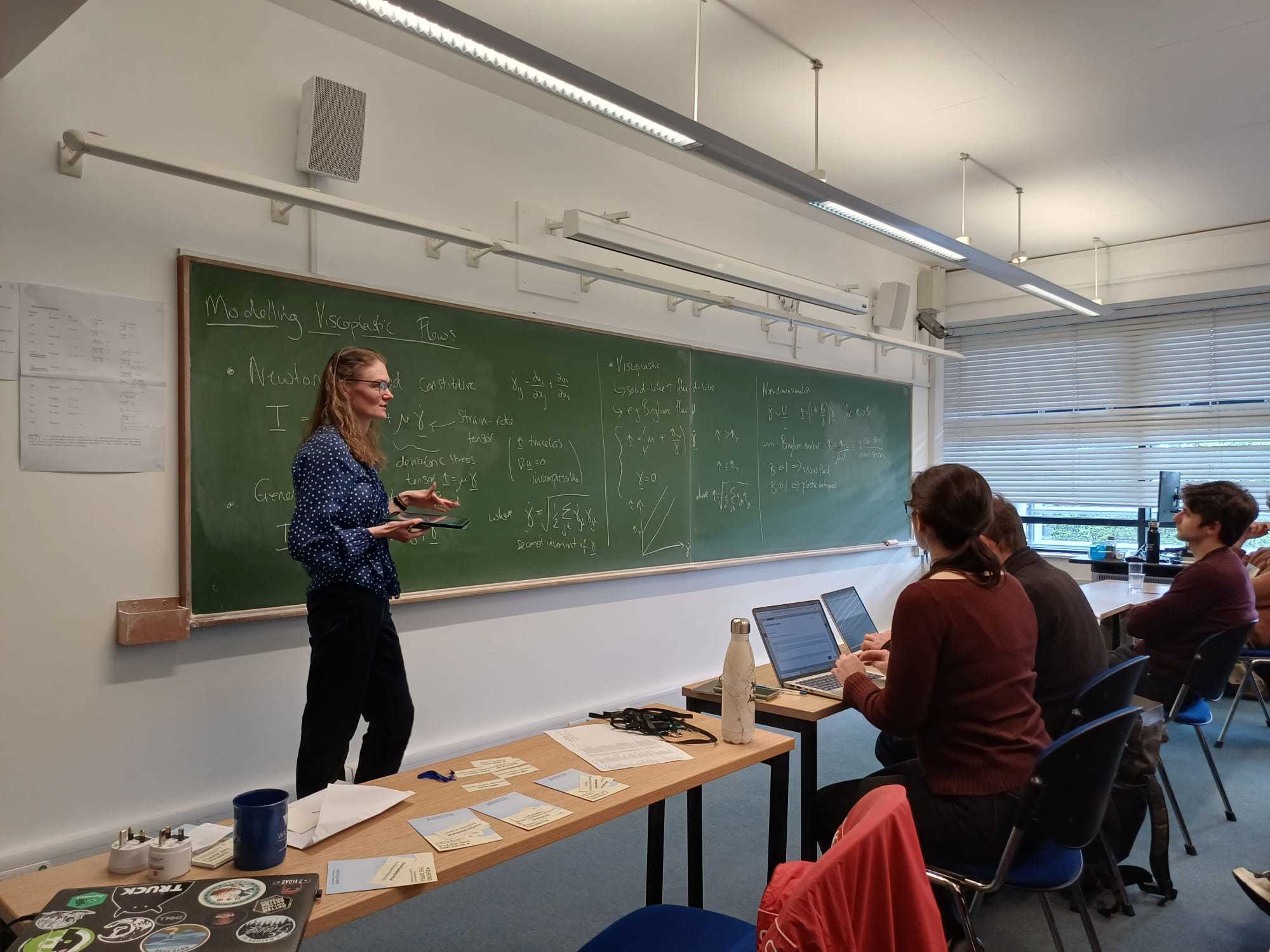
Dr. Ball expanding on the modelling of viscoplastic flows.
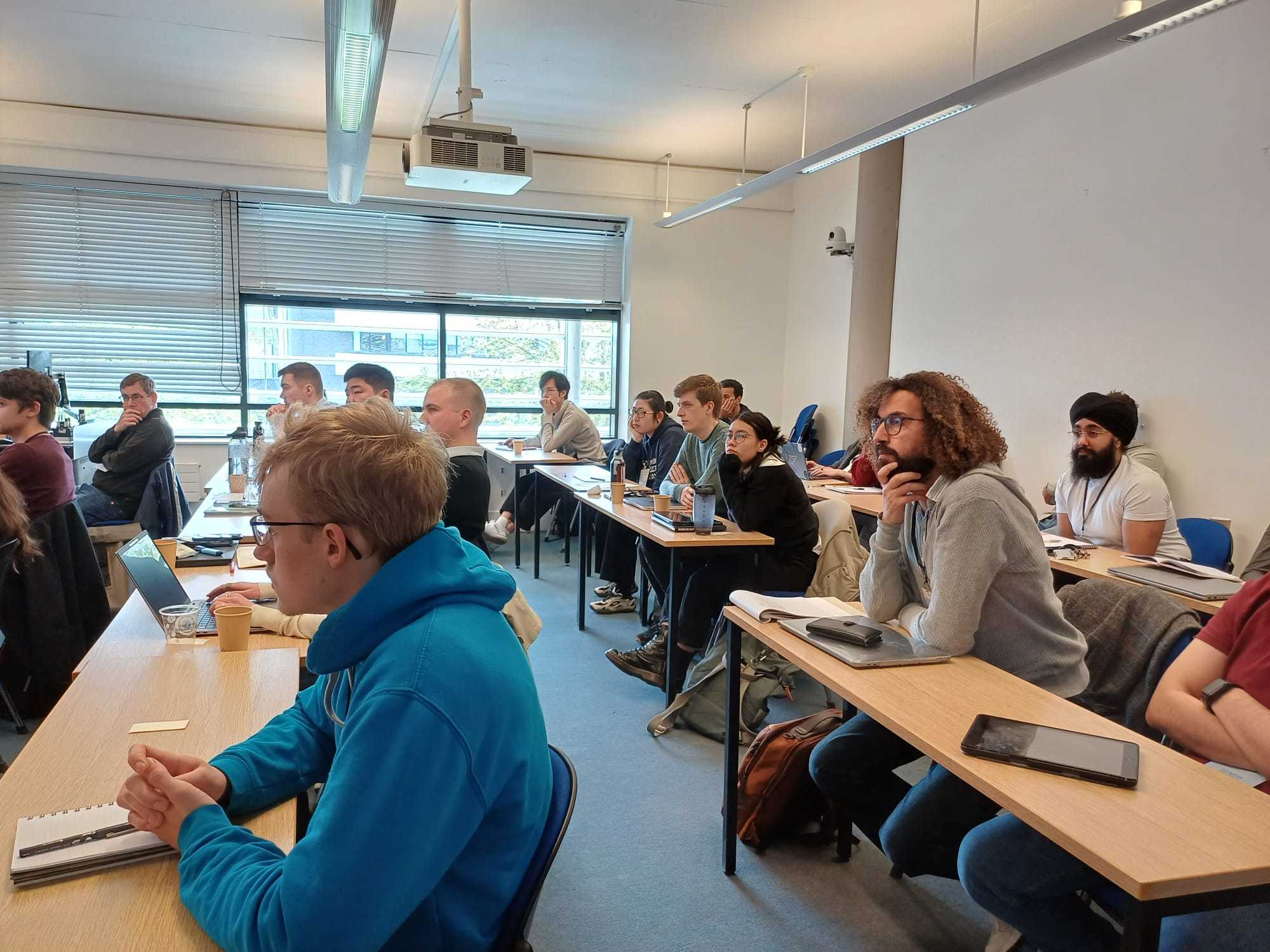
The participants.
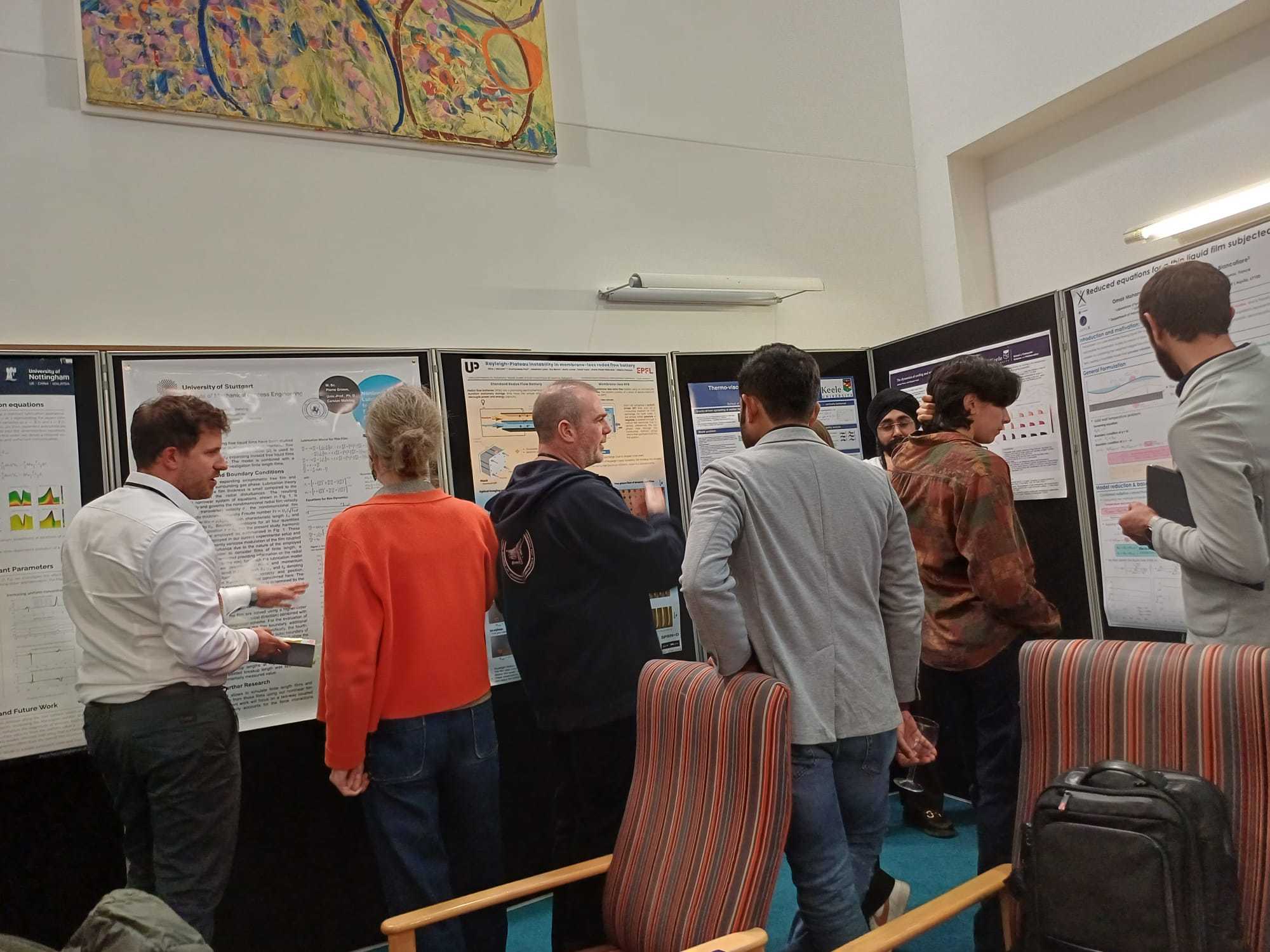
Participants exchanging ideas during the poster session.
 Pilot
Pilot Special Interest
 Knowledge
 ERCOFTAC