
ERCOFTAC PC France
The Atomizing Pulsed Jet
Authors: Yash Kulkarni, Cesar Pairetti, Raphael Villiers, Stephane Popinet
(Sorbonne Universite and CNRS, UMR 7190, Institut Jean Le Rond d’Alembert, Paris, France)
Stephane Zaleski
(Sorbonne Universite and CNRS, UMR 7190, Institut Jean Le Rond d’Alembert, Paris, France;
Institut Universitaire de France; UMR 7190, Institut Jean Le Rond d’Alembert, France)
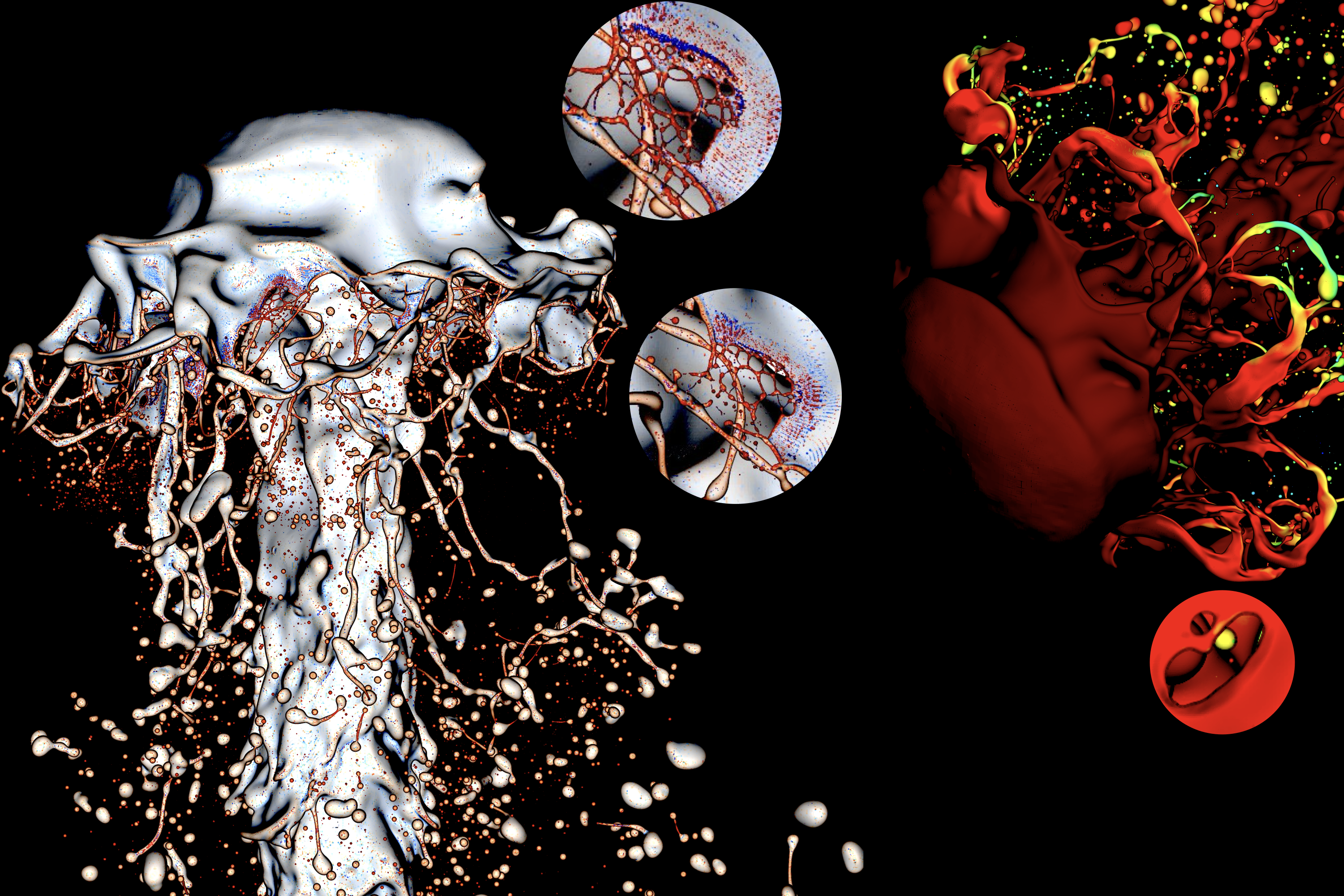
Thin-sheet rupture in an atomising pulsed liquid jet. Left: Default Volume-of-Fluid method, where curvature-colored interfaces reveal ripples that emerge as the sheet thins to the grid scale, triggering grid-dependent breakup. Right: Manifold Death breakup model, shown with interfaces colored by axial velocity, producing a cleaner and grid-converged sheet rupture. Insets highlight the contrasting thin-sheet rupture dynamics. See [1] for full details.
Scientific Abstract
Scientific Abstract Direct Numerical Simulations of the injection of a pulsed round liquid jet in a stagnant gas are performed in a series of runs of geometrically progressing resolution. The Reynolds and Weber numbers and the density ratio are sufficiently large for reaching a complex high-speed atomization regime but not so large that the small length scales of the flow are impossible to resolve, except for very small liquid-sheet thickness. The Weber number based on grid size is then small, an indication that the simulations are very well resolved. Computations are performed using octree adaptive mesh refinement with a finite volume method and heightfunction computation of curvature, down to a specified minimum grid size Δ. Qualitative analysis of the flow and its topology reveals a complex structure of ligaments, sheets, droplets and bubbles that evolve and interact through impacts, ligament breakup, sheet rupture and engulfment of air bubbles in the liquid. A rich gallery of images of entangled structures is produced. Most processes occurring in this type of atomization are reproduced in detail, except at the instant of thin-sheet perforation or breakup. We analyze droplet statistics, showing that as the grid resolution is increased, the small-scale part of the distribution does not converge, and contains a large number of droplets close in order of magnitude to the minimum grid size with a significant peak at d = 3Δ.
This non-convergence arises from the numerical sheet breakup effect, in which the interface becomes rough just before it breaks. The rough appearance of the interface is associated to a high-wavenumber oscillation of the curvature. This is exactly the stage depicted by the left image, where insets show the curvature noise originating close to the sheet rupture and associated grid-dependent ligament networks and droplets. To recover convergence, we apply the controlled “manifold death” numerical procedure, in which thin sheets are detected, and then pierced by fiat before they reach a set critical thickness hc that is always larger than 6Δ. This allows for cleaner sheet rupture and convergence of the droplet frequency above a certain critical diameter dc above and close to hc. The jet image on the right has an inset showing the clean rupture using the manifold death method. A unimodal distribution is observed in the converged range. The number of holes pierced in the sheet is a free parameter in the manifold death procedure, however we use the Kibble-Zurek theory to predict the number of holes expected on heuristic physical grounds.
Selected Recent Publications
References
[1] Y. Kulkarni, C. Pairetti, R. Villiers, S. Popinet, and S. Zaleski, The atomising pulsed jet, Journal of Fluid Mechanics, 1009, A35 (2025). doi:10.1017/jfm.2025.218
 Pilot
Pilot Special Interest
 Knowledge
 ERCOFTAC