20th ERCOFTAC Da Vinci Competition 2023 - Finalist
Yash Kulkarni
(Sorbonne Universite & CNRS, France )
"Theoretical and Numerical Modelling of Three-Phase Dynamic Contact Line and Atomisation"
- What was the topic of your PhD thesis?
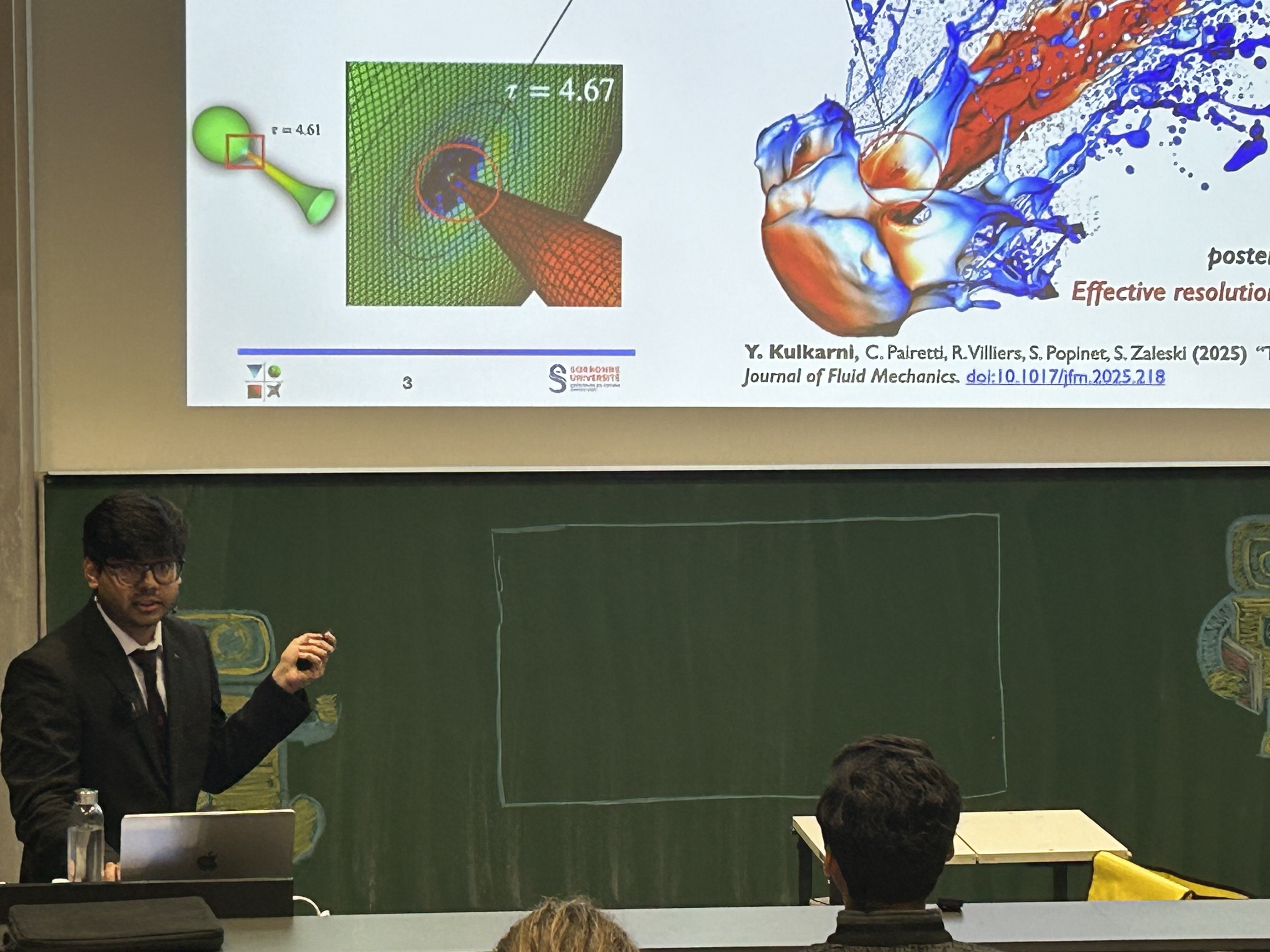
Yash Kulkarni - Finalist of
20th Da Vinci Competition 20
My PhD thesis focused on the theoretical and numerical modelling of three-phase dynamic contact lines and atomisation. It addressed two fundamental processes in multiphase fluid mechanics: (a) the motion of contact lines, where a liquid, a solid, and a gas meet, and (b) the fragmentation of fluids into droplets during atomisation. Both phenomena involve surface tension–driven multiphase flows and become notoriously challenging at microscopic scales due to singularities in classical models, which can predict unphysical infinite forces. My work combined analytical modelling with large-scale numerical simulations to develop physically consistent models and to understand these processes across a wide range of length scales.
- What does the Da Vinci competition mean to you?
The Da Vinci competition meant a great deal to me. It was a rare opportunity to interact with leading experts in fluid mechanics and to meet fellow finalists at a particularly meaningful moment, that is, just after completing the PhD, when one naturally reflects on their work and future direction. Being selected as a finalist was deeply encouraging, as it felt like a recognition of the value and relevance of my research. The event also helped me organise my ideas, receive valuable feedback from mentors, and build lasting professional connections and friendships.
- What did trigger your interest in STEM?
I have been interested in mathematics and science since childhood, which naturally drew me toward STEM. Beyond applications, I was fascinated at a fundamental level by how physical phenomena obey laws and how mathematics can describe systems ranging from astrophysics to biology.
It was during my BTech that I first encountered the phenomenon of bouncing droplets, where a droplet released onto a liquid pool does not immediately merge but can instead bounce several times without making direct contact. It may then partially merge, releasing a secondary droplet that repeats the cascade. I was struck by how such a simple experiment was governed by elegant mathematics with deep connections across many areas of physics. Later, learning about the mathematical challenges involved in modelling fluid flows—particularly through the Navier–Stokes equations—made me realise both the complexity and beauty of fluid mechanics. Wanting to contribute to the fundamental understanding and modelling of these phenomena ultimately motivated me to pursue a PhD.
- Do you have any advice for others in STEM?
My advice is to follow your curiosity while remaining open to learning beyond your immediate field. Many of the most exciting ideas emerge at the intersection of disciplines, so engaging with people from diverse backgrounds can be incredibly valuable. I also believe STEM has a crucial role to play in addressing global challenges, including climate change, sustainable technologies in agriculture, space, and healthcare. Combining fundamental curiosity with socially meaningful applications can make scientific work both rewarding and impactful.
- What motivates you in your work?
What motivates me most is the ability to model complex physical reality using mathematics. I am strongly curiosity-driven, and I find great satisfaction in seeing how abstract ideas can capture real-world behaviour with surprising elegance. Fluid mechanics, in particular, appeals to me as a unifying discipline. It connects mechanical engineering, civil engineering, chemical engineering, and environmental engineering with physics, mathematics and increasingly with computer science and AI. This breadth makes it an ideal field for exploring fundamental science while remaining connected to real-world problems.
- Where do you see yourself in five years?
In five years, I see myself continuing in academia, ideally as an assistant professor, leading independent research at the intersection of theory, computation, and applications in fluid mechanics.
- What advice would you give to new PhD students starting in fluid mechanics?
My main advice would be to let curiosity be the primary driver of your PhD. Fluid mechanics is a demanding field, as it often requires engaging with experiments, theory, and simulations, sometimes all at once. It is therefore easy to feel overwhelmed at times, and that feeling is normal and part of the process.
A PhD is not just about producing results; it is about becoming a scientist. This means learning how to ask questions, think independently, and develop ideas deeply. Having supportive advisors who encourage independence is invaluable, but ultimately, the responsibility for shaping your research and scientific identity lies with you. I would strongly encourage students to spend time on analytical thinking and modelling, as this is what sharpens physical intuition and helps one see beyond specific cases. Reading research papers regularly is also important—not only to stay informed, but to discover what truly excites you. If you enjoy thinking about the questions posed in journal articles, that is often a good sign you are in the right place.
Finally, never let moments of frustration extinguish your ideas. In fluid mechanics PhD, progress is rarely linear, but persistence, curiosity, and a genuine enjoyment of thinking about problems go a long way.
Da Vinci Presentation
Paper summary
Date: ERCOFTAC Autumn Festival, 9th - 10th October 2025 |
 Pilot
Pilot Special Interest
 Knowledge
 ERCOFTAC