20th ERCOFTAC Da Vinci Competition 2026 - Interview with Da Vinci Finalist
Deniz Bezgin
(Technical University of Munich, Germany)
Toward Machine-learned Discretizations and Differentiable CFD for Compressible Two-phase Flows
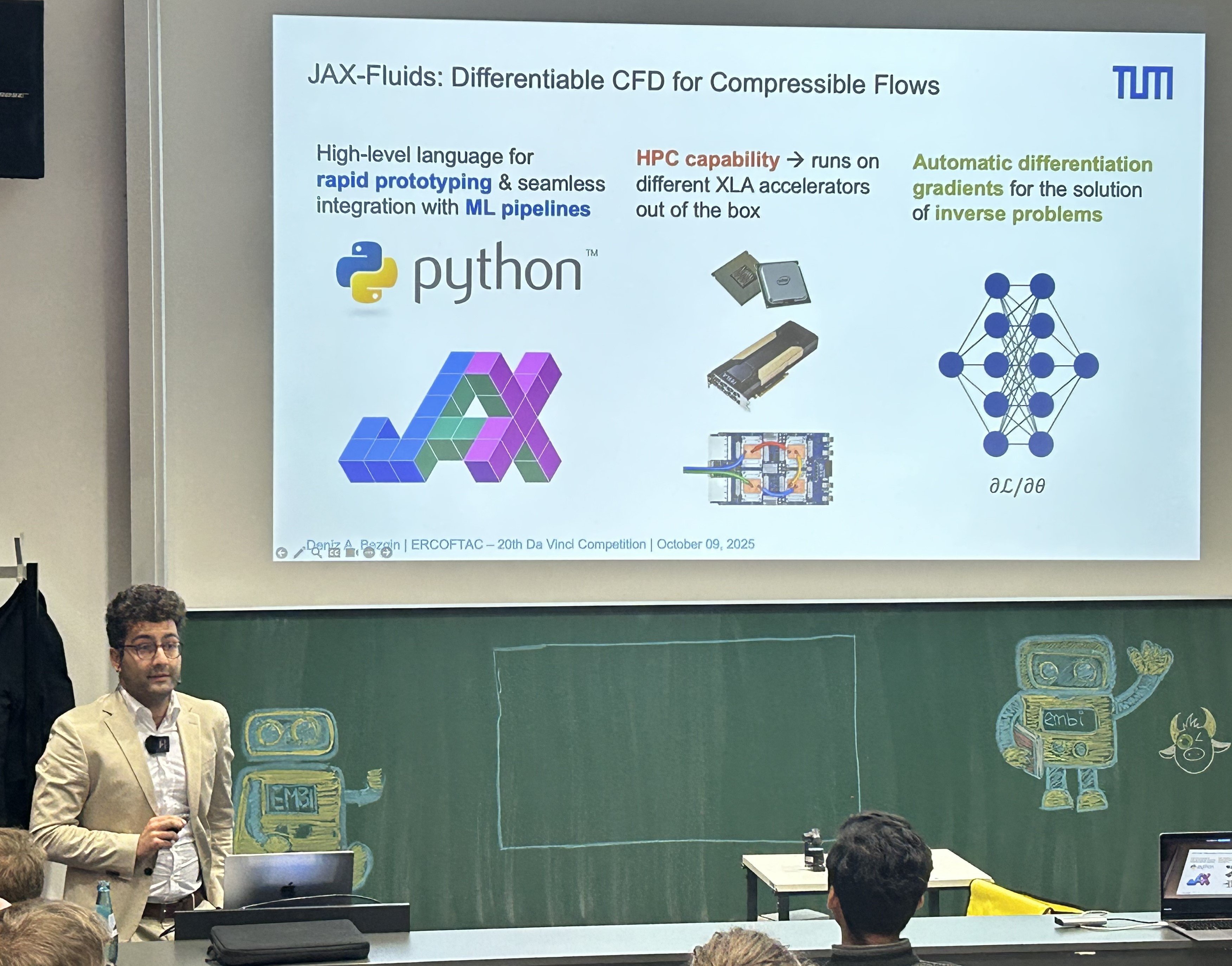
Deniz Bezgin - finalist
of 20th Da Vinci Competition 2025
- What is the topic of your Ph.D. thesis?
The topic of my PhD thesis was at the intersection of computational fluid dynamics (CFD) and machine learning. I focused on combining classical numerical methods and data-driven techniques and on developing a diCerentiable CFD solver that can be used both to train machine learning models and to solve inverse problems.
From a fluid mechanics perspective, my work concentrated mainly on compressible singleand two-phase flows. Such flows are central to many engineering applications, but they are also among the most challenging to simulate accurately and eCiciently. My research explored how machine learning and diCerentiable simulations can help address some of these challenges.
- What does the Da Vinci competition mean to you?
The Da Vinci competition is one of the most prestigious competitions for young researchers in fluid mechanics. Being selected among the five finalists was a great honor and a rewarding acknowledgment of the work carried out during my PhD. In addition, I very much enjoyed the opportunity to present and discuss my research with colleagues at the competition in Darmstadt, as well as to listen to the exciting talks given by my fellow finalists.
- What did trigger your interest in STEM?
My interest in STEM started at a very young age. I was particularly fascinated by rockets and curious about space exploration. I remember that my father showed me a picture of him standing next to a Saturn V engine, which I found very impressive. In high school, I particularly enjoyed physics and mathematics. This ultimately led me to pursue a degree in mechanical engineering, where I could combine science with real-world engineering applications.
- Do you have any advice for others in STEM?
There are so many exciting research directions in STEM that it can sometimes be diCicult to choose a path. My most important advice would be: don’t overthink it. If something sounds interesting, give it a try and see where it leads. In my experience, passion develops over time and through working on a topic.
- What motivates you in your work?
The beauty and complexity of fluid flows fascinate me. Fluid mechanics is full of challenging problems, and despite having spent several years in the field, I remain curious about the flow phenomena that surround us and am eager to explore new research directions. At the same time, I believe that machine learning oCers very interesting opportunities to address and revisit some of the outstanding problems in fluid mechanics. I am particularly motivated to combine data-driven methods with classical CFD to develop new tools for understanding, predicting, and optimizing complex flows.
- Where do you see yourself in five years?
I hope to continue building on the work that I started during my PhD. I believe that diCerentiable CFD and machine learning have the potential to address many exciting and challenging problems in fluid mechanics, and I would like to contribute to advancing these approaches while working with a team of inspiring colleagues.
- What advice would you give to new PhD students starting in fluid mechanics?
I really enjoyed my time as a PhD student because it gave me the opportunity to explore freely and to learn something new each and every day. My advice to new PhD students in fluid mechanics would be to make the most of this unique experience: be curious, ask tough questions, and be open to learning new things. At the same time, it is important to remember that there will be times when research progress is slow and when things don’t work out as expected. In such periods, I think it is important to trust yourself, believe in your work, and remain persistent. Overcoming these challenges often makes the eventual successes even more rewarding.
Da Vinci Presentation available here
Paper summary
Date: ERCOFTAC Autumn Festival, 9th - 10th October 2025
Department of Mechanical Engineering, Technical University of Darmstadt (Campus “Lichtwiese”)
Hosted by Pilot Centre Germany: TU Darmstadt, Germany
 Pilot
Pilot Special Interest
 Knowledge
 ERCOFTAC