
ERCOFTAC Best Practice Guidelines
Industrial Computational Fluid Dynamics of Single-Phase Flows
First copy free to new members of ERCOFTAC
ISBN - 978-0-9955779-2-3
Overview
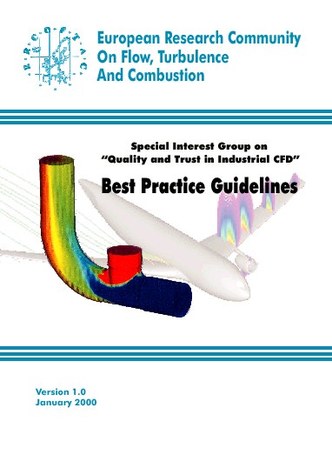
The Best Practice Guidelines (BPG) were commissioned by ERCOFTAC following an extensive consultation with European industry which revealed an urgent demand for such a document. The first edition was completed in January 2000 and constitutes generic advice on how to carry out quality CFD calculations.
- mesh design;
- construction of numerical boundary conditions where problem data is uncertain;
- mesh and model sensitivity checks;
- distinction between numerical and turbulence model inadequacy;
- preliminary information regarding the limitations of turbulence models etc.
Inevitably, the Guidelines cannot cover every aspect of CFD in detail. They are intended to offer roughly those 20% of the most important general rules of advice that cover roughly 80% of the problems likely to be encountered. As such, they constitute essential information for the novice user and provide a basis for quality management and regulation of safety submissions which rely on CFD. Experience has also shown that they can often provide useful advice for the more experienced user.
Content
The technical content is limited to single-phase, compressible and incompressible, steady and unsteady, turbulent and laminar flow with and without heat transfer. Versions which are customised to other aspects of CFD (the remaining 20% of problems) are planned for the future.
The seven principle chapters of the document address:
1. Numerical, convergence and round-off errors;
2. Turbulence modelling;
3. Application uncertainties;
4. User errors;
5. Code errors;
6. Validation and sensitivity tests for CFD models
7. Examples of the BPG applied in practice.
In the first six of these each of the different sources of error and uncertainty are examined and discussed, including references to important books, articles and reviews. Following the discussion sections, short simple bullet-point statements of advice are listed which provide clear guidance and are easily understandable without elaborate mathematics.
All such statements of advice are gathered together at the end of the document to provide a ‘Best Practice Checklist’. The chapter 'Examples' provides detailed expositions of eight test cases each one calculated by a code vendor (viz FLUENT, AEA Technology, Computational Dynamics, NUMECA) or code developer (viz Electricité de France, CEA, British Energy) and each of which highlights one or more specific points of advice arising in the BPG. These test cases range from natural convection in a cavity through to flow in a low speed centrifugal compressor and in an internal combustion engine valve.
The price per copy is:
- FREE to new members of ERCOFTAC (One copy per membership, plus p&p costs)
- €75 subsequent copies for members
- €230 for industrial non-members
- €140 for academic non-members and university libraries
- €75 for students (proof of registration at an accredited university and ERCOFTAC membership are required)
- €10 postage fee within Europe
- €17 postage fee worldwide
Purchase:
BPG Order Form
and return to:
Ms Magdalena Yates
Administration Manager
ERCOFTAC (CADO)
Email: admin@cado-ercoftac.org
Copyright statement: All rights reserved; no part of this publication may be reproduced, stored in a retrieval system or transmitted in any form by any means, electronic, mechanical, photocopying, recording or otherwise without the prior written permission of ERCOFTAC. ISBN - 978-0-9955779-2-3
Industrial Computational Fluid Dynamics of Single-Phase Flows
Reference: BPGSPF Hard Copy
Hard, printed copy
Member Prices (click to sign in)
Non-Member Prices
 Pilot
Pilot Special Interest
 Knowledge
 ERCOFTAC